

LDA Maintenance Charges 2026: New Tax for Lahore Societies
-
by Lahore Real Estate LRE
- October 29, 2026
- Blog
- 0
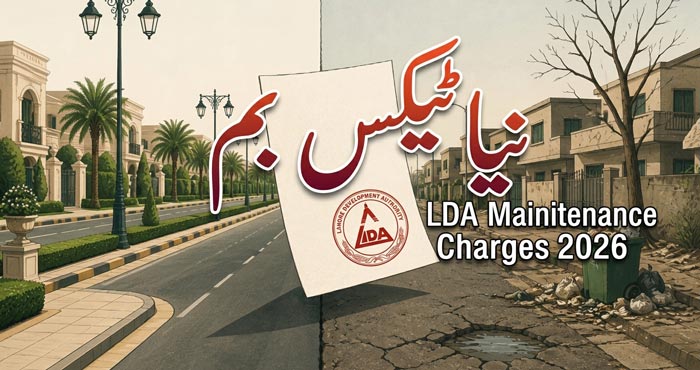
LDA New Tax Plan 2026: Maintenance Charges, Jubilee Town, LDA Avenue One and What Lahore Homeowners Must Know
The Rs2,500–3,000 monthly fee has already cleared LDA’s governing body. What is confirmed, what is still rumour, and what it costs a household.
A new monthly bill is coming to three LDA schemes
Residents of Lahore’s government-developed housing schemes already pay for plots, transfer fees, map approvals, property tax and the Suthra Punjab sanitation levy. Now the Lahore Development Authority wants a recurring monthly line item on top of all of it: a residential and commercial maintenance charge.
On paper it is simple. LDA will formally fund the services it is already supposed to provide — security, sanitation, garbage collection, green-belt upkeep and repair — and recover the cost from residents of its own schemes. Private societies have billed this way for two decades; LDA wants the same model, starting small and expanding if it works.
The uncomfortable version: an authority with a record revenue year is asking middle-income homeowners to pay a second time for infrastructure the state already charged them to build.
What has actually changed since the proposal first surfaced
Most commentary — including widely shared videos — still calls the charge a proposal for LDA maintenance charges”awaiting approval” and quotes token amounts of a few hundred rupees. Both points are out of date.
On 19 August 2026, LDA’s governing body approved its budget for fiscal year 2026-27 and, in the same meeting, cleared a pilot project for imposing maintenance charges alongside improved sanitation and municipal services in three schemes. Services are free for the first two months, after which billing begins. The decision came from a governing body meeting chaired by Vice Chairman Mian Marghoob Ahmad; Chief Minister Maryam Nawaz Sharif chairs the authority itself, which is why the proposal is associated with her office.
The reported numbers are also materially larger than those circulating online. Media reporting on the approved pilot puts residential charges at Rs2,500 to Rs3,000 per month, with commercial properties at roughly double the residential rate — Rs5,000 to Rs6,000 and upward. The fee is tiered by plot size, from 3 and 5 marla up to 10 marla and one kanal. Over a year, a household at the top band faces roughly Rs36,000 in new fixed cost that no owner here has ever budgeted for.
| Property type / size | Monthly (reported) | Annual equivalent |
|---|---|---|
| Residential — 3 & 5 marla | Rs2,500 approx. | Rs30,000 |
| Residential — 7, 10 marla & 1 kanal | Rs3,000 approx. | Rs36,000 |
| Commercial (all sizes) | Approx. 2× residential (Rs5,000–6,000+) | Rs60,000+ |
One clarification matters for accuracy: reporting on the approved pilot names LDA Avenue One, Jubilee Town and LDA Enclave for LDA maintenance charges. Earlier coverage of the proposal referenced Avenue One, Jubilee Town and LDA Avenue, and some commentary has added Johar Town. Johar Town is not confirmed in the approved pilot list, so residents there should treat the charge as a future possibility rather than a current bill.
The three pilot schemes and why they were chosen
Jubilee Town, launched in 1998, spans roughly 4,100 kanals across blocks A to F — one of LDA’s largest schemes, and one where ageing infrastructure makes maintenance a real issue rather than a theoretical one.
LDA Avenue One is newer, with 5 marla, 10 marla and one-kanal plots and steady possession handovers. Owners already paid development charges in the plot price, which makes a recurring fee harder to justify. LDA Enclave completes the pilot as a contained test case.
The design is deliberate: three schemes, two months free, then a bill. If collection holds, the model extends to every LDA scheme in the city — the part homeowners elsewhere should be watching.
The WASA bill question
The most contentious element in circulation is enforcement. Commentary claims the charge will ride on WASA utility bills so that non-payment triggers a water disconnection — a direct parallel with the old PTV licence fee collected through WAPDA bills whether or not a household owned a television.
That comparison lands because the logic is identical: attach a civic charge to an essential utility and refusal becomes impossible. But label it correctly.
If the charge does ride on WASA bills, the practical consequence is severe: a disputed Rs3,000 fee could cost a family its water connection.
Where the money goes: an Rs88.6 billion question
Commentary often cites an LDA budget of Rs50–60 billion. The approved figure is far larger. LDA and the Traffic Engineering and Planning Agency (TEPA) carry an Rs88.613 billion budget for 2026-27, with a revenue target of Rs47 billion. LDA also posted a record Rs32 billion in revenue last year, its highest ever.
Within that: Rs10 billion borrowed from the Punjab government for structure-plan roads, Rs6.3 billion for ADP schemes, Rs12.5 billion for LDA City, Rs13.5 billion for sustainable development and urban regeneration, Rs4 billion for LDA Avenue 1, Rs3.5 billion for TEPA.
This is not a cash-starved authority, which is why the fairness question is unavoidable: if LDA can allocate Rs13.5 billion to beautification and regeneration, why must a 5 marla homeowner in Jubilee Town fund garbage collection separately? Residents deserve an annual, scheme-by-scheme account of what maintenance revenue pays for.
The equity problem nobody wants to discuss
The strongest argument against the charge is not the amount. It is the asymmetry.
Elite corridors — Main Boulevard, Main Gulberg, and the commercial spine around Fashion Avenue — have received tiled footpaths, landscaping, lighting and sustained redevelopment funded from the same public purse. Property values there are measured in billions. Those owners are not being asked for a monthly maintenance fee. Middle-class scheme residents, already squeezed by record inflation and rising utility tariffs, are being asked to pay for pothole filling and trash collection.
There is also double charging. Scheme residents paid development charges at allotment, paid map approval and completion fees, and still pay property tax and the Suthra Punjab sanitation levy. Adding a municipal maintenance charge without rebating overlapping levies risks charging twice for one service. Punjab has already shown how far this stretches — the Suthra Punjab garbage levy, the Suthra Punjab Authority Act 2026, even a reported Rs2,500 hospital sanitation charge.
What owners and buyers should do now LDA maintenance charges
In the pilot schemes: do not pay until you have a written demand stating the legal basis, your plot-size slab, the service schedule and the collection channel. Ask your residents’ association for the governing body minutes. If the two “free” months deliver nothing, document it — that record is your strongest ground for challenge.
Elsewhere in LDA schemes: assume expansion, not exemption, and budget a maintenance provision.
Buyers: treat it as a permanent ownership cost. Rs36,000 a year capitalised at prevailing yields changes the return on a rental unit, and belongs in your offer price. Confirm with LDA — not a dealer — whether a scheme sits inside the pilot.
Civic route: every rupee collected under the maintenance head should be traceable in LDA’s published accounts, with beautification spending across elite and middle-income areas disclosed.
Frequently asked questions
Is the charge approved or still a proposal?
A pilot was approved by LDA’s governing body on 19 August 2026 alongside the FY2026-27 budget. Rates and collection mechanics are being finalised.
How much will residents pay?
Reported at Rs2,500–3,000 per month for 3, 5, 7 and 10 marla and one-kanal homes, with commercial property at roughly double — about Rs36,000 a year at the top band.
Will non-payment cut my water connection?
Reported and widely discussed, but unconfirmed in official coverage. Demand written confirmation of the default mechanism.
Does it apply to Johar Town?
Not in the approved pilot, which names LDA Avenue One, Jubilee Town and LDA Enclave. Expansion elsewhere is the stated intention.
Does this replace any existing tax?
No rebate has been announced. It sits alongside property tax, the Suthra Punjab levy and past development charges.





Join The Discussion
You must be logged in to post a comment.